Skip to main content
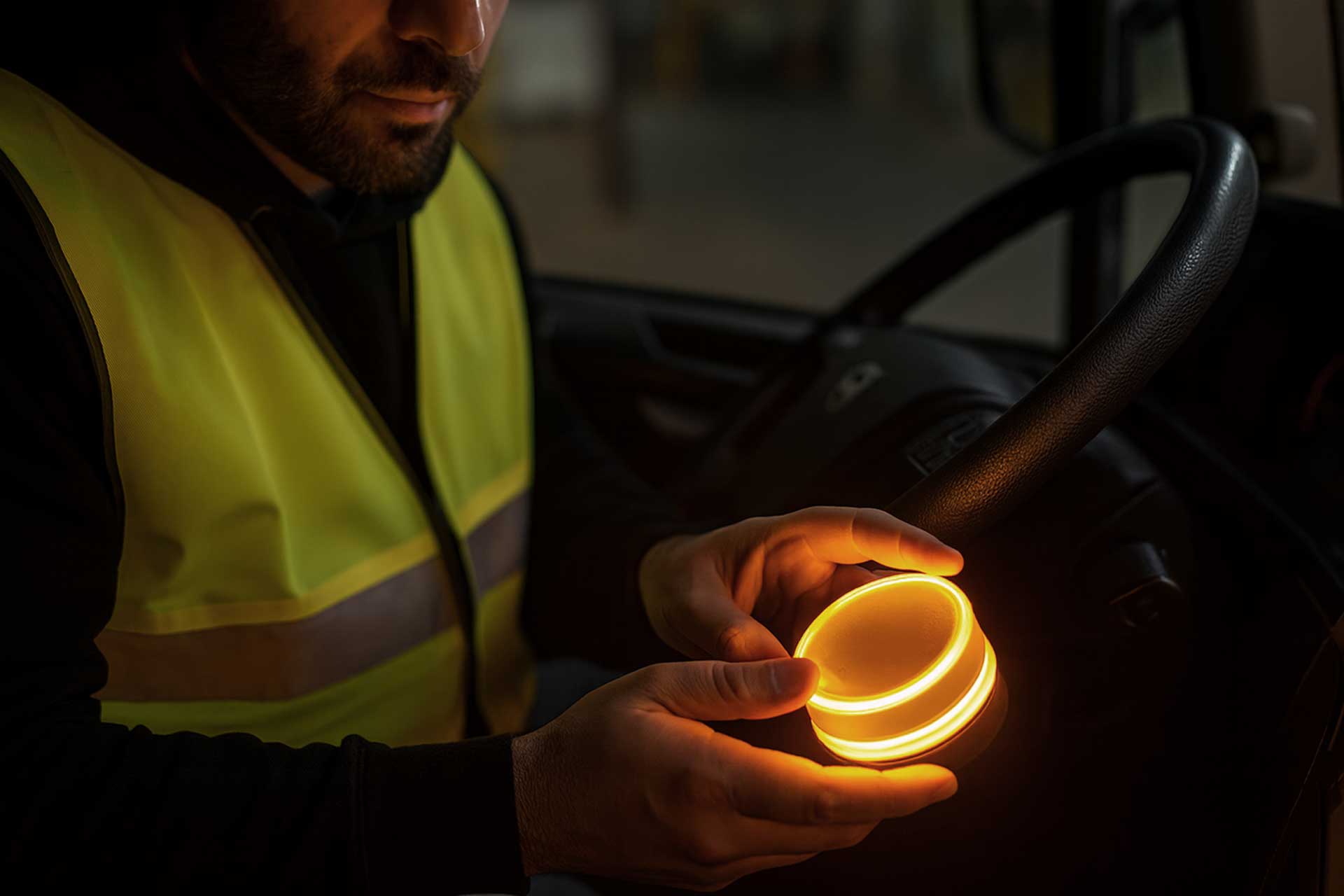
If you work in logistics (as a professional driver, traffic manager or fleet manager), this is for you: the connected V16 beacon replaces the warning triangles and has a date marked in red on the calendar. As of January 1, 2026, it will be the only legal device in Spain for signalling a stopped vehicle on the road.
In this article, we explain clearly and without beating around the bush what the connected V16 beacon is, who is required to carry it (and who isn’t, if coming from abroad), from when it applies and who is responsible for providing it when we talk about fleets, subcontractors and self-employed drivers.
What the connected V16 beacon is (and what makes it different)
The connected V16 beacon is an emergency flashing device that:
-
Emits a flashing light to make the stopped vehicle visible.
-
When activated, it automatically sends your location to the DGT 3.0 platform, creating “virtual visibility” (alerts in navigation systems, apps, panels, etc.).
What matters for a professional driver:
-
No phone or app required: it works independently.
-
It includes a built-in SIM card, and regulations require a minimum of 12 years of connectivity included (with no extra fees for the user).
-
The DGT highlights the main reason: avoiding the need for the driver to step out and walk on the road to place triangles, reducing the risk of being hit.
Where it must be placed and how to use it
-
It must be easily accessible (ideally in the glove compartment).
-
It should be placed “at the highest point possible” on the vehicle; if reaching the roof isn’t feasible (truck/bus), the DGT allows placing it on the driver’s door.
When it becomes mandatory in Spain
-
From January 1, 2026, the connected V16 beacon will be the only legal device for signalling immobilised vehicles and will replace warning triangles in Spain.
-
Until that date, there is a transitional period (BOE regulation) in which previous solutions may still be used, but the “finish line” is 01/01/2026.
Who is required to carry it (logistics and professional drivers)
In Spain, the DGT is clear: from 2026, (among others) vehicles used for the transport of goods must carry it as an onboard accessory, in addition to passenger cars, mixed-use vehicles and buses.
Translated into logistics:
-
Trucks (and non-special combinations, according to the DGT text)
-
Vans / delivery vehicles
-
Buses
-
Motorcycles: not mandatory, although recommended for safety.

International drivers / foreign vehicles: do they need to carry the connected V16 beacon?
Here’s the key for import/export:
✅ Vehicle registered in Spain
Even if the driver is foreign or the company is multinational: if the vehicle is registered in Spain, Spanish regulation applies and it must use the connected V16 beacon from 2026. The DGT defines this as an obligation to carry the device onboard.
🚚 Vehicle registered in another country operating internationally in Spain
The DGT has issued a specific instruction: vehicles registered abroad that circulate in Spain under “international circulation” are considered compliant if they carry and use warning triangles (or an equivalent device according to their national regulations).
In summary:
-
Spanish plate → connected V16 beacon (from 01/01/2026)
-
Foreign plate in international circulation → may continue using triangles (according to their regulations)
Who must provide it in fleets, subcontractors and self-employed drivers?
In professional transport, the practical approach (and the one that best matches what the DGT publishes) is to treat it as vehicle equipment, not as “driver equipment”:
-
The DGT refers to “carrying it in the vehicle” and storing it in an accessible place inside (glove compartment), and the list of obligated vehicles refers to the type of vehicle, not the driver’s employment status.
So, in real operations:
-
Company vehicle / company-owned fleet: the logical thing is for the company (owner/fleet manager) to purchase it and assign one to each unit.
-
Subcontractor: each company must ensure that its vehicles comply, just like with safety vests, documentation, etc.
-
Self-employed driver with their own vehicle: normally provided by the driver themselves (because equipment goes with the vehicle).
-
Self-employed driver using a company vehicle: same rule applies: if the vehicle belongs to the company, it is reasonable that the company provides it for that vehicle.
A practical “frontline” tip to avoid problems: one connected V16 beacon per vehicle, included in the departure checklist (along with tachograph, documentation, PPE…).
Privacy: what is sent (and what is NOT)
This topic creates some noise, so here’s the summary based on the official source:
-
When activated, the connected V16 beacon sends the vehicle’s location and a technical identifier of the device.
-
That identifier is not linked to a person nor to the license plate, and no personal data is required to purchase it.
-
When switched off, it does not transmit data, and when switched on, it cannot be used to reconstruct movements like a “tracker”.
Important: not just “any” device is valid. It must be certified
According to the DGT: only certified brands and models listed as approved in their official list are valid.