
Answering “yes, of course” when asked if you comply with GlobalG.A.P., BRC and IFS is easy. The difficult part comes when the question that really matters during an audit or an incident appears:
“Perfect. Show me.”
In logistics, GlobalG.A.P., BRC and IFS are not usually failed because of “poor transport”, but for something much more common: not being able to prove with documentation, traceability and clear communication that everything was done as required.
And here’s the good news: a large part of that compliance doesn’t depend on magic, but on organization. That’s where Orus Logistics comes in: a tool designed to centralize documentation and communication, with role-based access so each party (exporter, carrier, importer) sees and uses only what corresponds to them.
The key question: do you comply… or are you just trying?
If you work with clients who require GlobalG.A.P., BRC and IFS, the reality is this:
-
You can do things “right” operationally.
-
But if your evidence is scattered across WhatsApp, emails, random PDFs and calls, when it’s time to prove it… you’re going to struggle.
And in certifications, struggling = risk:
-
Non-conformities during an audit.
-
Claims that are difficult to resolve.
-
Conflicts between parties because of “I said / you said”.

What GlobalG.A.P., BRC and IFS have in common in logistics (what gets reviewed the most)
Although each standard has its nuances, day-to-day logistics tends to revolve around the same four blocks. And yes: they’re exactly the ones that usually break down when information is scattered.
1) Document control and evidence (not “random files”).
You are expected to present:
-
Relevant procedures and instructions (receiving, loading, incidents, condition control…).
-
Records proving compliance (deliveries, incidents, verifications).
-
Up-to-date documents (version control and change traceability).
With Orus Logistics:
Everything stays in a single main repository, organized and accessible. When someone asks “Where is it?”, the answer is “right here”. No chasing anyone.
2) Real traceability (one step back and one step forward).
The typical requirements in logistics:
-
Identifying shipments, batches or references and linking them to inbound/outbound movements.
-
Reconstructing what happened, when and with what impact.
-
Responding quickly during audits or drills.
With Orus Logistics:
Orus helps ensure traceability isn’t based on “memory and luck”. Every communication, alert, incident and piece of evidence is linked to the operational context, reducing the chaos of piecing stories together from screenshots.
3) Communication and alerts for incidents (and proof that the alert was sent).
Certifications value (and often require) the existence of:
-
Incident records (rejections, damage, delays, cold chain issues, etc.).
-
Alerts sent to the appropriate parties (exporter/importer/operations).
-
Evidence of corrective actions and follow-up.
With Orus Logistics:
Orus turns “I told you on WhatsApp” into traceable, retrievable alerts with full history. This is gold when an incident escalates or an audit comes into play.
4) Customer requirements agreed before the service (and not lost)
In certified logistics, “we’ll figure it out later” doesn’t work. You need:
-
Agreed product and service requirements (conditions, time windows, specifics).
-
Clear roles (who validates, who confirms, who receives).
-
A record of changes (any variation must be documented).
With Orus Logistics:
Orus ensures each operation has its own organized “black box”: agreements, changes, confirmations and evidence, without relying on whoever happened to be “copied in” on an email.
So… are you really complying with the GlobalG.A.P., BRC and IFS certifications?
Ask yourself these questions (audit mode ON):
-
Can you find the documentation and evidence for a specific shipment in under 2 minutes?
-
Can you clearly prove when you reported an incident and to whom?
-
Do your clients and partners access what they need without you re-sending PDFs or adding them to 20 email threads?
-
Does traceability depend on one person… or on the system?
If any answer is “it depends”, “sort of”, or “I’d have to check”… then there’s an opportunity.
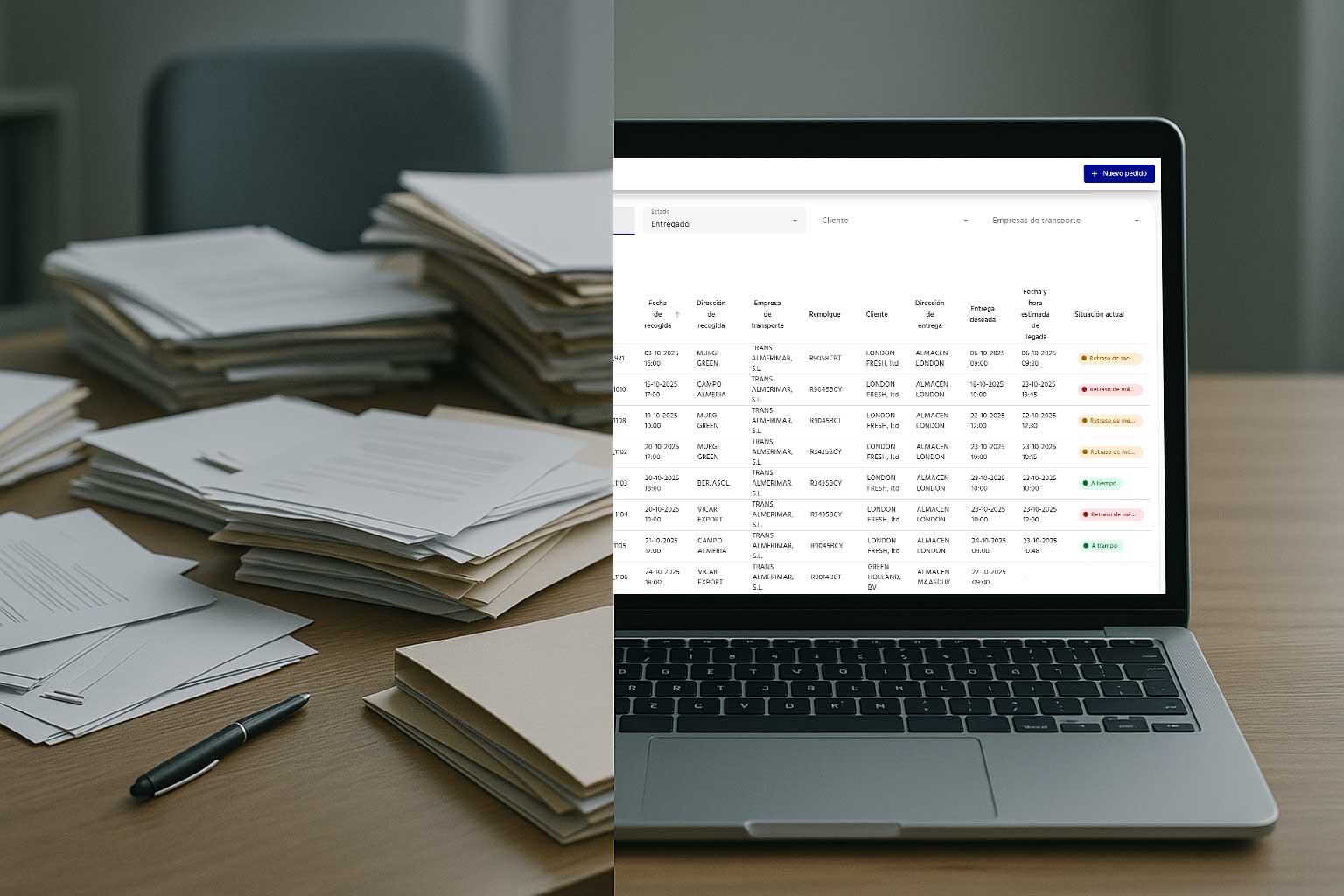
Why Orus fits so well with GlobalG.A.P., BRC and IFS (in logistics)
Because these certifications share a healthy obsession: order, evidence and traceability.
Orus helps you build all of that with three simple ideas:
- A single repository (single source of truth). No scattered information. Everything important lives in one place.
- Role-based access (each party sees only what they should). Exporter, importer, traffic operations, warehouse — each one accesses only what corresponds to them. Less noise, more control.
- Documented communication (alerts, incidents and follow-up). What used to be “a phone call” is now a record you can prove.
In certifications, the one who wins is not the one who works the most, but the one who proves it best.
GlobalG.A.P., BRC and IFS may have differences, but in logistics the story is always the same: those who have documentation and traceability under control compete better, argue less and get through audits with far less drama.
Orus Logistics makes compliance easier for you. And when you work with demanding supply chains, that’s worth a lot.
Want to see how it works in a real exporter–carrier–importer workflow?
Request a demo of Orus Logistics and we’ll show you how to centralize documentation, traceability and alerts with role-based access.