Do you think the warehouse where you collect the goods is responsible for preparing the Electronic Administrative Control Document (DeCA)? Or that, if another company manages it for you, you no longer need to check it? Be careful, because the regulations establish specific responsibilities, and delegating its management does not release you from them.
The mandatory digitalisation of the DeCA has raised questions among carriers, freight forwarders, logistics operators and shipping companies. One of the most common is determining who is responsible for preparing the document and, above all, who is liable if it contains errors or has not been completed correctly.
Let’s clear things up.
The warehouse where the goods are loaded is not necessarily responsible for the DeCA
One of the most common misconceptions is that the warehouse, cooperative or logistics centre where the goods are collected is automatically responsible for issuing the DeCA.
However, physically loading the goods does not make a company responsible for the administrative control document.
The warehouse may prepare documentation, provide information about the goods or assist with transport management, but its legal responsibility depends on the contractual role it plays.
Therefore, we must not confuse the location where the goods are loaded with the company legally responsible for completing the DeCA.
Digitalising the DeCA does not change who is responsible
Since 5 October 2026, the Administrative Control Document must be used in digital format for transport operations subject to this requirement.
However, the transition from paper to electronic format does not change the responsibilities established under Order FOM/2861/2012.
The regulations identify two key parties:
- Contractual consignor: the company or professional that directly contracts the transport service with the actual carrier.
- Actual carrier: the company or professional holding the transport authorisation under which the transport is physically carried out.
Both parties must participate in the proper completion of the DeCA and are responsible for the accuracy of the information assigned to them under the regulations.
This means that digitalising the document is not simply about replacing paper with an electronic file. It is also important to have a process that correctly identifies the parties involved and manages the information each is responsible for providing.
Who is responsible for the DeCA when subcontracting is involved?
In freight transport, it is common for several companies to be involved: consignors, freight forwarders, logistics operators and carriers that may, in turn, subcontract transport services.
In these situations, it is particularly important to identify who contracts directly with the carrier that ultimately performs the transport.
Let’s look at a simple example.
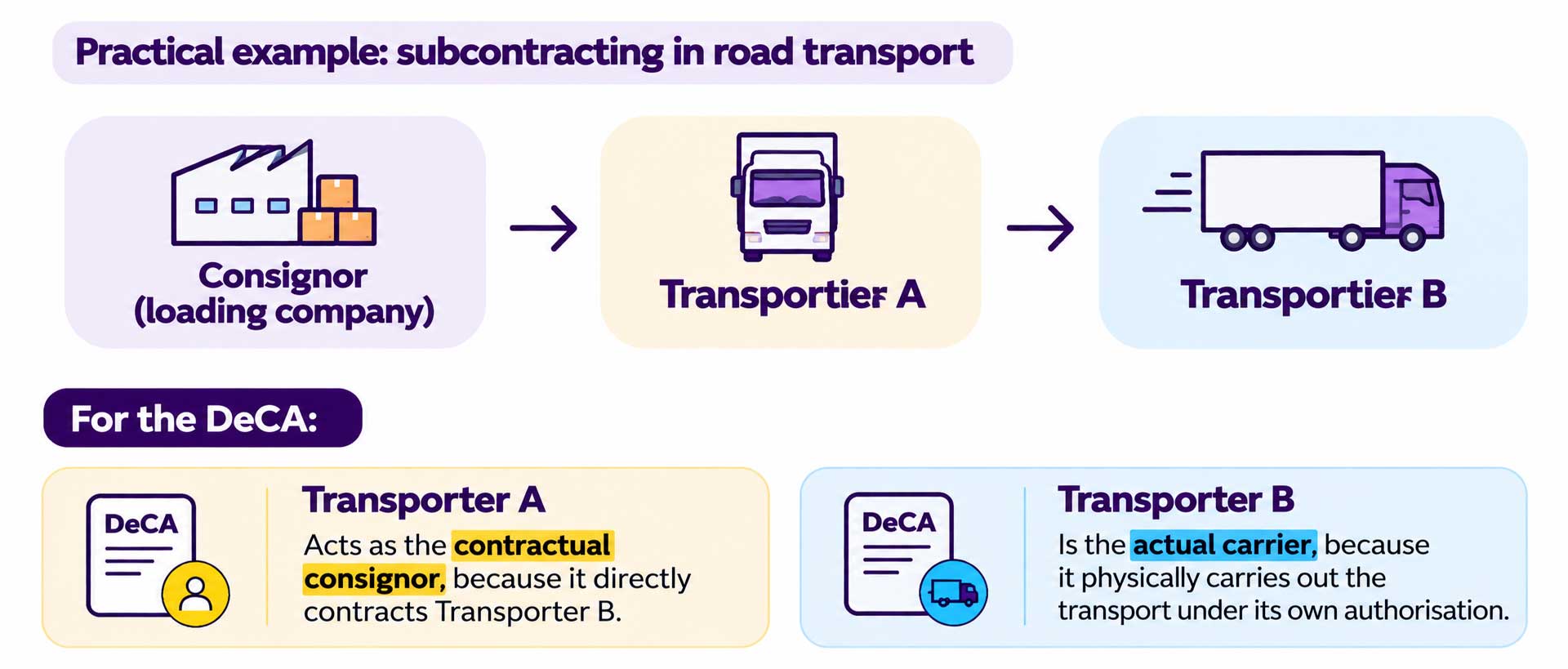
A company hires Carrier A to transport goods, but Carrier A decides to subcontract the service to Carrier B, which ultimately carries out the transport.
The chain would be:
Shipping company → Carrier A → Carrier B
In this case, for DeCA purposes:
- Carrier A: acts as the contractual consignor because it directly contracts Carrier B.
- Carrier B: is the actual carrier because it physically carries out the transport under its own authorisation.
Therefore, the obligations relating to the completion of the DeCA fall on Carrier A and Carrier B.
This principle also applies when freight forwarders or logistics operators are involved: what matters is identifying who contracts directly with the actual carrier, rather than simply who owns the goods or where they are collected.
What information is each party responsible for in the DeCA?
Order FOM/2861/2012 establishes what information the document must contain and who is responsible for ensuring its accuracy.
The contractual consignor is responsible for:
- The identification details of the contractual consignor.
- The identification details of the actual carrier.
- The origin and destination of the shipment.
- The nature and weight of the goods being transported.
The actual carrier is responsible for:
- The identification details of any special circulation permit, where required.
- The date on which the transport takes place.
- The registration numbers of the vehicles used, including those of the tractor unit and semi-trailer or trailer, where applicable.
Each party is also responsible for any remarks or observations they add to the document.
This division of responsibilities makes it clear which information each participant must verify and is essential for preventing errors and potential non-compliance.
Be careful: delegating DeCA management does not mean delegating responsibility
It is common for companies to leave the preparation of the document to third parties, either for convenience or as part of their normal operational processes.
For example, warehouse staff may be responsible for entering the information, or a freight forwarder may use a platform to generate the documentation.
However, there is one important thing to remember:
Delegating the preparation of the DeCA does not automatically transfer the legal responsibilities of the contractual consignor or the actual carrier.
If the document is not properly completed, mandatory information is missing or it contains incorrect details, the legally responsible parties may face the consequences established by the regulations.
Responsibility for inaccuracies is determined according to the information assigned to each party. In addition, both parties have obligations regarding the proper completion and availability of the document during transport.
That is why relying on another company to handle everything without checking the information can lead to problems.
What matters is not who enters the information, but who is legally responsible for ensuring that the information assigned to them is correct.
Orus Logistics: each party manages its own information, with everything recorded
At Orus Logistics, we have developed a platform that simplifies the management of the Electronic Administrative Control Document, taking into account the responsibilities of each participant.
Our solution allows the contractual consignor and the actual carrier to participate directly in creating and completing the DeCA, with each party providing the information they are responsible for.
This gives both parties greater control over the document and their involvement throughout the process.
In addition, Orus Logistics allows you to:
- Maintain traceability: keep a record of document management activities and the actions carried out by each party.
- Keep documentation under control: access the DeCA history and easily track documents.
- Reduce errors: avoid relying exclusively on information entered by third parties.
- Simplify daily operations: manage documents quickly and easily without adding unnecessary complexity to everyday tasks.
- Support regulatory compliance: use a tool that helps organise and properly document the entire process.
Because digitalising transport should not simply be about eliminating paperwork. It should also improve communication, control and coordination between the companies involved in each transport operation.
Manage your DeCA documents hassle-free
With Orus Logistics, you can create and manage your Electronic Administrative Control Documents quickly, easily and affordably.
What’s more, you can get started completely free with your first 25 DeCA documents, with no subscriptions or long-term commitments.
Start managing your DeCA documents today, hassle-free and at no cost.
Ready for the digital revolution in transport? Discover how ORUS can transform your logistics communication and your customers’ experience.